Copyright © 2012 Dan Fulwiler Painting & Decorating. All Rights Reserved. Web Development and Hosting by Web Site Solutions. Powered by WordPress.
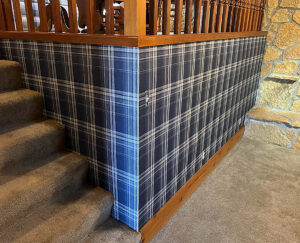
I recently installed upholstery fabric on the walls of a new conference room for an area hospital. Probably one of the most difficult installations I have ever completed. The fabric showed-up with loose, puffy, un-seamed edges and so table trimming was necessary before hanging. The fabric was acrylic backed, which helped keep the surface clean, but still required installation as a ‘dry-hang’.
A dry-hang is a technique used when the surface of the fabric needs to stay dry because the paste would stain the fabric. To dry-hang fabric, the paste is applied to the wall with a roller, much like paint would be applied, then the fabric is pasted to the wet wall, making certain not to get any paste on the surface of the fabric. The fabric seams can be ‘butt-fit’ if an accurate enough table trim is accomplished before hanging. If the table trim is more of a ‘rough cut’ to get rid of frayed edges, then the fabric should be overlapped and a double-cut seam used. Be careful not to paste too far ahead or the paste will dry-out before you can get there. I usually only paste enough wall to allow hanging and seaming one sheet at a time.
The ‘closet area’ was especially difficult as it entailed wrapping a bulkhead with an underside return into an inside corner. It is actually very funny that the most difficult part of the installation was in the ‘least important’ area… an area that almost no one will notice… unless it is done incorrectly, or in an amateurish way. I looked at the bulkhead for quite a long while, trying to figure out how I was going to wrap this thing without having it look silly. Finally, I decided the only way to do it right, was to hang separate sheets into the inside corner on the front of the thing, thus allowing enough overlap for me to miter a herringbone effect right down the middle of the sheets, keeping the ‘corner’ line intact from ceiling to floor. Pretty cool, even if I do say so myself!
The fabric, as you can see, is a horizontal string… very soft to touch… most likely a cotton blend. Because it was a horizontal pattern, I checked with the manufacturer to confirm the product would ‘panel’ when installed. ‘Panelling’ is a term used to describe wallpapers, especially fabrics, that will ‘show’ each and every ‘panel’ of fabric hung… because it is literally impossible to hide the seams. Once established, it was easy to explain to the client, by creating sample boards. Each seam would need to be cut with a straight edge and level, and each seam would need to be an equal, measured distance apart. This required planning each wall’s install, much like the same way tile is planned, so that odd-sized panels are placed at the edges of walls. Sounds easy? it is when you hire a seasoned professional like Dan Fulwiler!
On the front wall, where a drop down video screen comes from the ceiling, the designer had me install a very smooth, paper-backed vinyl with a subtle vertical stripe in it. the contrast of textures, colors and patterns where the two products meet adds quite a bit of interest to an otherwise plain, uneventful, corner area. The room is so simple, yet so detailed, I really enjoyed the challenge of this installation.
From wallpaper, to commercial vinyl… silks, strings, grass-cloths, hides… or just about anything else you can think of to paste to a wall… Dan Fulwiler is the guy to call!
Call Us Today!
Continue Reading »
Dan Fulwiler is accepting new clients!
First come, first served!
Call me: 262-224-4062
E-mail me: dan@danfulwiler.com
Send me a letter: PO Box 14, Horicon, WI 53032
when you need clean, straight-forward, nothing-too-fancy type painting… call Dan.
When you need something a little bit more special, call Dan.
Or, when you need something really unique, like a mural of your favorite spot on the water… you guessed it, call Dan!
Painting, Staining, Varnishing, Polys, Lacquers, & Shellacs, Stenciling, Faux Finishing, Trompe L’Oeils & Murals, Carved Plaster Restorations and of course, Wallpapers, Commercial Vinyls, Fabrics and so much more…
Whatever your painting/decorating needs may be, Call Dan!
Continue Reading »
I am afraid of some of the materials I have handled in the past. Letting my hands literally soak in things like glaze mixtures and artist’s pigments which contain things like naptha and touluene, day after day, week after week, year after year. One of my artist friends suggested wearing gloves… but then I can’t “feel” what I am doing.
Ultimately, I descided I would paint with house paint… which is specifically designed to be low VOC and not very toxic at all. Of course, it does contain some toxins, as all paints do… like crystalline silica and ethanol… but, overall, is waay less toxic than most artist’s pigments.
I was able to make the switch because Most of my work consists of murals and faux finishes. So, of course, I say to myself, if you are going to paint on a wall, why not use wall paint?
I was able to find a matte paint, which has a very nice translucency to it, which I then buy by the quart and load into squirt bottles to carry in my mural/faux paint kit. No one knows I am using common house paint and the results are stunning, and durable! The translucency of the product forces me to build-up layers of color, just like I would need to do with an artist’s pigment. Also. the colors mix together to create new colors… just like artist’s pigment… and so I find that with a “kit” of only twelve colors, I can mix and blend almost any other color I want. In my “kit” of twelve colors, I have a deep blue color, a very bright yellow, and the hottest red I could find in their color deck. I also keep a pure, clean white, and a deep black (based on green). What are the seven colors missing yet? Earth tones, of course! Using the manufacturers color deck, I choose colors that would most closley resemble a raw umber, burnt umber, raw sienna, burnt sienna, and an ochre. I do carry a deep green, a medium purple and a bright orange (secondary colors) because even though I am able to create these colors from the primary set, I find it is a great time-saver to have a basic secondary color set that you can “shift” to the exact shade or tint you want.
The “Blue Heron” mural on this page was painted in 32 hours using Sherwin Williams Duration Matte interior latex paint!
So… there you have my answer to “how to avoid the toxicity of artist’s pigment” How do you avoid the toxins in paint? Write to me and let me know!
I hope this was helpful. Got a question for Dan? Leave a reply on my Contact page!
Continue Reading »
When you bid on a job, do you calculate your price based on time & materials, or do you charge a certian amount per square foot?
The correct answer is: Yes. I calculate my bids using both a per saquare foot formula and also using a T&M (time & materials) formula. I figure the job out both ways and then compare the two numbers. If I did my math right, the two numbers should pretty much agree. If one of the numbers is radically off from the other number, I know I missed something, or added something wrong, and need to look at it again.
I also use the T&M method to do reverse math on my final number, so I can tell a crew how many hours they have to do a job. This can be a great motivator for crews that want to work hard and bring a job in under hours (there are usually bonuses involved here). Some crews don’t really care about the bonus and do it for reputation… those are the crews I like best!
Also, there are times when you simply can’t put an hourly price on something and will have to rely on the square foot method. This is especially true on large jobs. I have also seen situations where I simply did not trust a square foot price and decided I would only do the job as a T&M. When this happens, your customer is going to want you to include a “Not to Exceed” price in your contract. Don’t forget to protect yourself with a “Not to be Less Than” price as well. When I painted my truck the first time, I thought it would be an all day affair… it only took a couple hours. If that were a paint job for a customer, as a T& M, with no minimum, I would have cut my own throat, so to speak…
So… that’s the skinny on how I bid. Write to me and tell me how YOU bid a job!
Got a painting question for Dan? Leave a reply on my Contact page
… and Good Will to All Men (and Women)!
My beautiful wife gave me a helicopter for Christmas, and I would say the look on my face say’s this photo was taken just prior to a crash landing!
Loads of fun, and more difficult than you might think… I highly recommend this toy!
Continue Reading »
My entry for the sCary Art Contest at Raven Gallery… Saturday, October 29th, 2011 from 6pm to 9pm with a Killer after-party where we can pillage and plunder the sleepy little hollow called Pewaukee! Raven Gallery, Pewaukee, Wisconsin, Saturday. October 29th at 6pm… Be There or Be an equilateral quadrangle!
Continue Reading »
When a door (or window) is a different color on the outside than it is on the inside, where should the two colors meet?
Good question! Doors and windows are considered part of the trim package, and usually will paint or stain to match the trim of the room they are in. On a frame, the outside edge of the stop is the correct place to end a color. On a door, the edges should match the room they face when the door is open. The edges of double-hung windows are not visible and should only recieve oil-based primer or stain, never any paint or varnish. The edges of casement windows, although visible when open, should match the room they open out from.
Here are some photos of a door I recently painted in a “split” showing the color change at the outside edge of the stop.
Sometimes, a door, or window sash won’t match it’s frame at all. For example, I just bid on a job that specifies painted, hollow metal frames with pre-finished, stained wood doors. This happens alot in commercial work. The frame should still split if the hallway, or outside is a different color trim than the room the door is in. When you are doing this kind of work, I reccomend doing the stain and varnish first, then the painted edge last. This is because you can paint over stain, but you really can’t stain over paint, so doing it in the right order will achieve a cleaner edge that the painter will have more controll over. It’s a really cool look if you just take your time and try to create the straightest, cleanest edge possible: after the varnish on the stained side has dried, you can over-paint that edge by just a little bit and immediately clean the edge with a damp rag wrapped around your finger. dampen the edge before you paint and this trick works even better! I hope that answers it for ya. If not, let me know and I’ll try to elaborate! Good luck and Happy Painting!
Got a painting question for dan? Send it to dan@danfulwiler.com and get it answered here!
Continue Reading »
That depends on what I am painting. But, for the most part, I find that a 1:4 ratio of paint to glaze is ideal for most faux finishes. First of all, what is glaze? Glaze, scumbol, extender, medium… all are basically, more or less, the same thing. There are subtle differences between them, and we use them for different purposes, but, for the most part, they all are kind of like an “un-tinted” paint. This is a very simplistic answer, but for the sake of today’s discussion, it will suffice.
There are many different ways to spell these things, so don’t let that throw you. Scumol is the same thing as scumble, and glaze is the same as glase, or… I have even seen it called glaseing… (don’t ask me, I still haven’t figured out where they came up with that spelling). For our part, we usually refer to it as glaze.
So what is it, and how do I use it?
Glaze is a medium, acrylic or oil based (although the oil based mediums are being phased out), with less sicative (drying agent) and more polymer emulsion, glaze is used to add transparency to paint. This transparency makes it possible to show what is underneath. The degree to which an under-layer shows is dependent, in part, on how much glaze is added to the paint. More glaze equals more transparency. Be careful, too much glaze will equal too much transparency and your effect will be “lost.”
Other factors that will affect the level of transparency in your glaze will be the color(s) you are using, the specific effect you are applying, and the number of layers you will be adding.
I find that for most two to three color faux finishes, I need more glaze than paint. Here is how I do it: I select colors with my client, a “main” color that will show the most… this color usually matches the floor treatment, furniture or window treatments, a secondary color that will show a lot… this color is usually a compliment to the main color, and, sometimes, a third “accent” color that will show only a little. Of course there are dual schemes, monochromes, and a host of other ways to relate color… but this method will work for all of them.
It is also important to note that for this discussion, I am talking about mixing glaze with common, interior house paint, always in an egg shell, satin or semi-gloss finish, including the undercoat, or first coat, of paint. My personal preference is to work with eggshell. You should not use a matte finish unless you are very skilled and looking for a specific effect, as most fauxs will dissappear into a matte finish.
So… my client wants me to match the colors in her Tiffany lamps (which are all over the house), and use these colors to create a tertriary (three color) color wash on the walls of her living room. When I am done matching the three most prevalent colors in the lamps, I have “Marble Head Gold,” “Butter Cream Yellow” and “Cold Blue Steele” for my tertriary scheme. The client wants the effect to be light and airy and so the blue color needs to be the one that shows the least.
I mask-off the room and paint the walls the blue color… solid… top to bottom… the husband comes home from work and FREAKS-OUT!! The walls in his living room are a dark, gray-blue and this is not at all what they wanted! I ask them to calm down and in two more days, when I am done with the room, if they don’t like it, they don’t have to pay for it.
The next day, I mix one quart of the yellow color with one gallon of glaze and one cup of water. I use this mix to “color-wash” the walls with a big four inch barn brush. The next day, I mixed one quart of the gold color with one gallon of glaze and repeated the same color wash technique, but with a smaller, three inch brush… being careful never to over-do it, and always allowing some of what is underneath to show through. These mixes are for huge rooms… for smaller areas, mix less material, but in the ratio 4:1 with a splash of water.
When I was finished, and the room was un-masked and the furniture put back in place, my client not only paid me, they took me out to lunch and insisted I do the rest of the house! We spent several months there and made each room unique while maintaining a natural “flow” of color and pattern from one room to the next. I know it is a low quality photo… this job is from ten years ago, but you can see the gray-blue color peeking through from under the yellow and gold. The same colors, were used to create venetian plaster in the dining room, above a crackle effect we did below the chair rail. For the venetian plaster, we allowed a little more of the blue to show through and we reversed to order of the gold and yellow so the living room would be predominantly gold and the dining room would be more yellow… per the client’s request. The crackle is the same steely-gray-blue with only the yellow color on top. One of my favorite jobs so far!
Continue Reading »
On the home decorating network, some of the painters say to roll a wall up and down, and some say to roll side to side, and yet others seem to go all over the place namby-pamby… so… which is it?
The answer is , smoothing the paint out so no roller marks show will negate the importance of which direction you roll. I usually roll up and down, making sure to keep a wet edge, and always rolling back into the area I just previously rolled. Sometimes, it is easier to roll sideways (underneath chair-rail, for instance), but even then it is still important to keep a wet edge and roll an area back into the wet edge, to eliminate roller marks.
What is a bad idea is painting in giant letters on a wall, a “W” or an “X” and then coming back to smooth it all in and try to get rid of all those random roller marks. I have seen many walls with a subtle “M’ or “N’ showing through the paint because the painter began by rolling a giant letter out and then was not fast enough to cover the entire wall with a wet edge… bad painter.
A simple up and down, vertical stripe, worked back into itself, is the most efficient use of energy and material.
A ceiling should always be rolled twice, in opposite directions, on consecutive days. Cutting in straight lines and edges should be done prior to rolling, so the roller can cover most of the brush marks.
Continue Reading »
Beth asks:
The previous owner painted a really dark color and I want to make it white. What’s the best way to get rid of the dark color?
Good Question!
If you know me at all, you know I’m going to say… PRIMER!
But… which primer, or what qualities in a primer am I looking for? Well, we already discussed which brands of paint are my favorites and those same brands make excellent primers. They also make more than one kind of primer, to accomplish different goals. There are stain-hiding primers like Killz and Binz, but these are generally pretty nasty, chemically speaking, and should only be used in extreme situations like smoke damage or graffiti. We can also buy specialty primers for sealing new drywall, primers for sizing a wall for wallpaper, primers for filling-in the holes of a cinder-block wall before painting it… basically, we can find a specific primer for almost any job!
The ingredient in primer that provides the most “hide” is titanium dioxide. Hide, refers to a color’s opaqueness, or, ability to cover, or hide, what is underneath. Other ingredients used for opaqueness include diatomaceous earth, zinc oxide, talc, limestone and the list goes on from there! I have found the primers that have the best hiding chemistry in them are Sherwin William’s, Benjamin Moore’s and Behr.
Another thing you can do to your primer to help it hide better is to add a little bit of pigment to it. Gold is a high-hiding pigment when combined with a small shot of black. In a gallon of Sherwin William’s Contractor’s Primer, I ask the guy (or gal) at he desk to add, “One shot of gold and two shots of black, to help add a little hide” …I don’t really know how much a “shot” is, but it gives the paint technician the idea that I know what I’m doing and so they add an appropriate amount and I end up with the lightest of gray colors… and I seem to get good hide out of it.
If your primer is applied thick, like paint, evenly worked out, allowed to dry thoroughly, and it has a little bit of hiding pigments, there is no reason two coats of finish paint wouldn’t completely cover and hide whatever is underneath. The things that go wrong here is painters who like to cheat and skip coats of paint, or use thin, inferior products, and textures showing through from an old faux or bad repair.
As far as cheating painters go, we need only say that the industry standard is, and has been for a thousand years, one coat of primer followed by two coats of paint. This is the BARE MINIMUM amount of material to cover ANY surface. Anything less is unacceptable and I, as an honest contractor, would not even offer it. After all, I am expected to warranty my work, and so skimping on anything is nothing less than foolhardy. The same is true when it comes to paint. A good paint is thick, smooth and creamy… it takes some work to spread it out and smooth it in. The stir stick will stand in the bucket, all day long… that’s a good paint!
A good primer, like a good paint, will cost a little more, but in the end, it will be worth it. Cheap primers tend to perform poorly and a weak primer will result in a weak paint job. Remember, the primer isn’t just covering-up what is underneath, the primer is grabbing on to whatever is underneath and providing a “tooth” or “grip” for the new paint to hang on to!
As far as old textures showing through, this will become apparent after the primer has dried. A great painter will see this problem and fix it before the primer even goes on, a good painter will see this problem after the primer has been applied and he will fix it and then re-prime… the hacker will ignore the issue all the way through to the final coat and the customer will be left wondering why he can still see the stripes on the wall. It’s because the stripes were created with masking tape and the paint left a little, raised ridge when the tape was removed. This ridge was unnoticeable when the stripes were what showed, but now that the wall is one color, you can see every stripe! The painter should have used a knife to shave-off the ridge before the primer was ever applied. It’s not the stripe that’s showing… it’s the ridge. This same problem can come from covering-up rag-rolls and sponge-painting… almost any faux can leave a “pattern” on your wall that will need to be sanded-off, or “float-coated” over, or dealt with in some other way before the primer goes on. The same holds true for repairing and / or duplicating any textures that were / are present, like: sand texture, knockdown or orange-peel.
As you can see, there is a little more to consider when preparing a surface for paint than what the average person might think of. It’s a good reason to consider hiring an experienced, talented, professional… like me!
Let me know if I missed something, or if you need more info!
Continue Reading »